 Flamico
How to stop porn urges: what to do in the next 10 minutes

When a porn urge hits, it doesn’t feel like a thought. It feels like a pull, physical and urgent, like it will only grow until you give in. It won’t. An urge is a wave: it builds, it peaks and it fades. You don’t have to defeat it forever. You only have to get through the next ten minutes, and this page shows you exactly how.
- Say it: “This is an urge. It will pass.”
- Stand up and leave the room. Leave your phone behind.
- Breathe in for 4 seconds, out for 6. Ten times.
- Do 20 push-ups or splash cold water on your face.
- If it’s still loud, text someone: “Rough moment, can we talk?”
Why porn urges feel so strong, and why they always pass
An urge is your brain making a prediction. Over time it has learned that a certain moment, being tired, bored, stressed, lonely, or alone with your phone, is followed by a fast reward. So when that moment shows up, your brain starts asking for the reward before you’ve decided anything. That’s why urges feel automatic: in a way, they are.
But a prediction that isn’t met starts to fade. Every time you ride an urge out without acting on it, you teach your brain that this moment doesn’t lead where it expected. Over weeks, that’s how urges come less often and with less force.
What makes an urge last longer is feeding it: replaying images, “just checking” social media, negotiating with yourself, or staying alone in the same place doing the same thing.
And here’s the part most people get wrong: trying to force the thought out of your head usually backfires. In a classic experiment, people told not to think about a white bear thought about it more, and when they were later allowed to think about it, it came back even stronger.1 Fighting the thought keeps it at the center of your attention. The plan below does something different. It lets the urge be there while you change everything around it.
There’s evidence that this works. In one study, smokers who learned to notice a craving and “surf” it, watching it rise and fall without acting on it, didn’t report weaker urges. But they smoked noticeably fewer cigarettes in the week that followed.2 The urge didn’t change. What they did with it did.
The 10-minute plan
Read this once now, while you’re calm. The point is to make every decision in advance, so that in the moment you just follow the steps.
Minute 0: Name it
Say it, out loud if you can: “This is an urge. It will pass.” It sounds too simple to matter, but naming a feeling changes how your brain handles it. In a brain-imaging study, simply putting a feeling into words reduced activity in the amygdala, a region involved in strong emotional reactions.3 You go from being inside the urge to noticing it. That small distance is where your choice lives.
Minute 1: Move your body, change the room
Stand up and leave the room you’re in, especially if it’s your bedroom or bathroom. Put your phone face down, or better, leave it behind. Turn on the lights. Open a window. Where you are and how you’re sitting are part of the habit’s script. Change them, and the script breaks.
Minutes 2 to 4: Breathe slowly
Slow breathing is one of the fastest tools you have to calm your body down. A review of studies on slow breathing found it’s linked to a shift toward the body’s rest-and-recover state, along with more relaxation and less anxiety.4
- Breathe in through your nose for 4 seconds.
- Breathe out slowly through your mouth for 6 seconds.
- Repeat for two or three minutes. Let your shoulders drop on every out-breath.
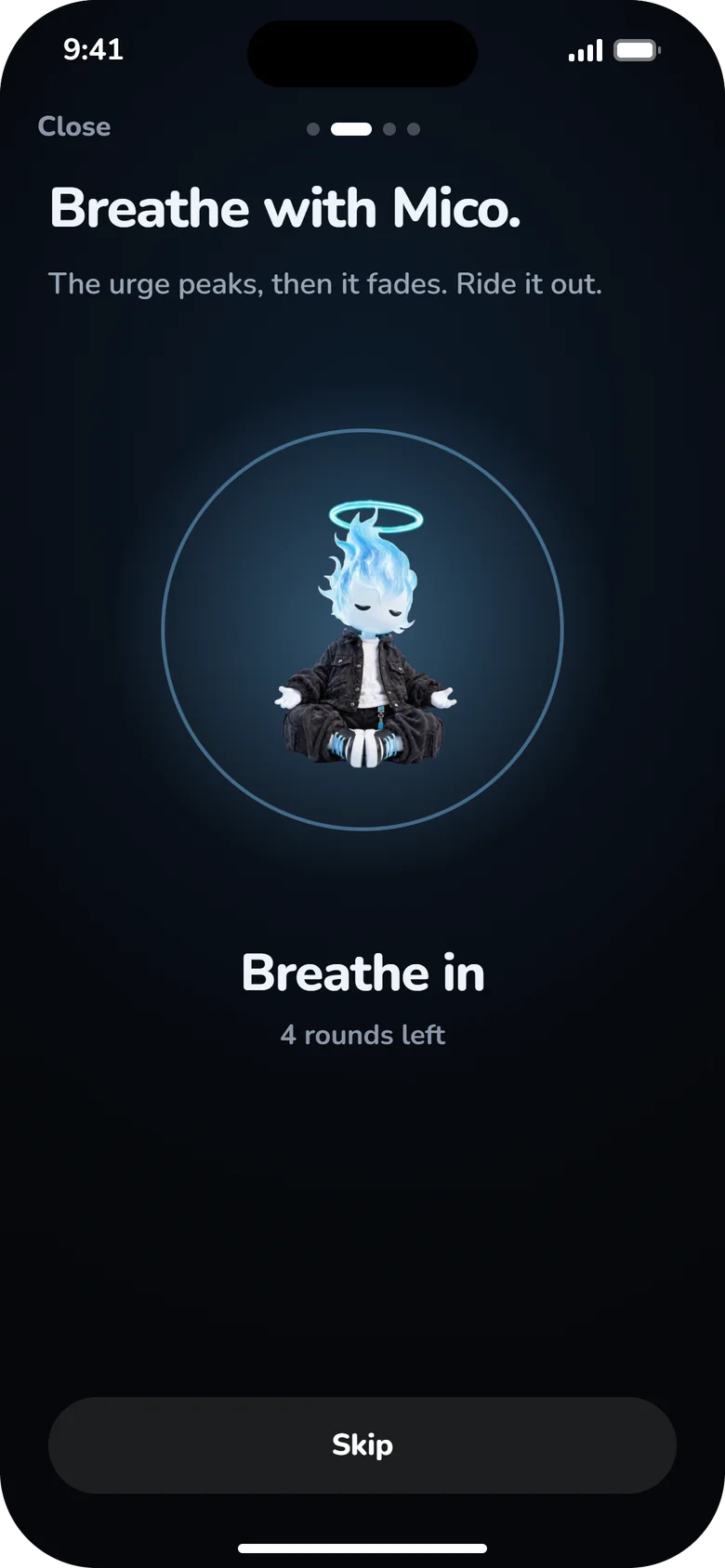
If you feel light-headed, go back to breathing normally. In Flamico, Mico breathes with you, round by round, so you don’t have to count.
Minute 5: See your reason
In the middle of an urge, your brain only cares about the next few minutes. Your reason pulls it back to the next few years. Read the sentence you wrote about why you’re quitting, or watch the short video you recorded on a good day. Hearing your own voice cuts through in a way a note can’t, which is why Flamico plays your video first when you press “I feel an urge”.
Minutes 6 to 8: Do one physical thing
Pick one and do it now, not after you’ve thought about it:
- 20 push-ups or squats.
- A cold shower, or cold water on your face and wrists.
- A brisk walk around the block.
- Make tea, eat something, drink a full glass of water.
This isn’t random advice. Research on smokers found that even short bouts of exercise reduced cravings.5 Moving your body changes your state and competes with the urge for your attention.
Minutes 9 to 10: Reach out, or lock it down
If the urge is still loud, don’t white-knuckle it alone:
- Text or call someone. You don’t have to explain. “Rough moment, can we talk?” is enough.
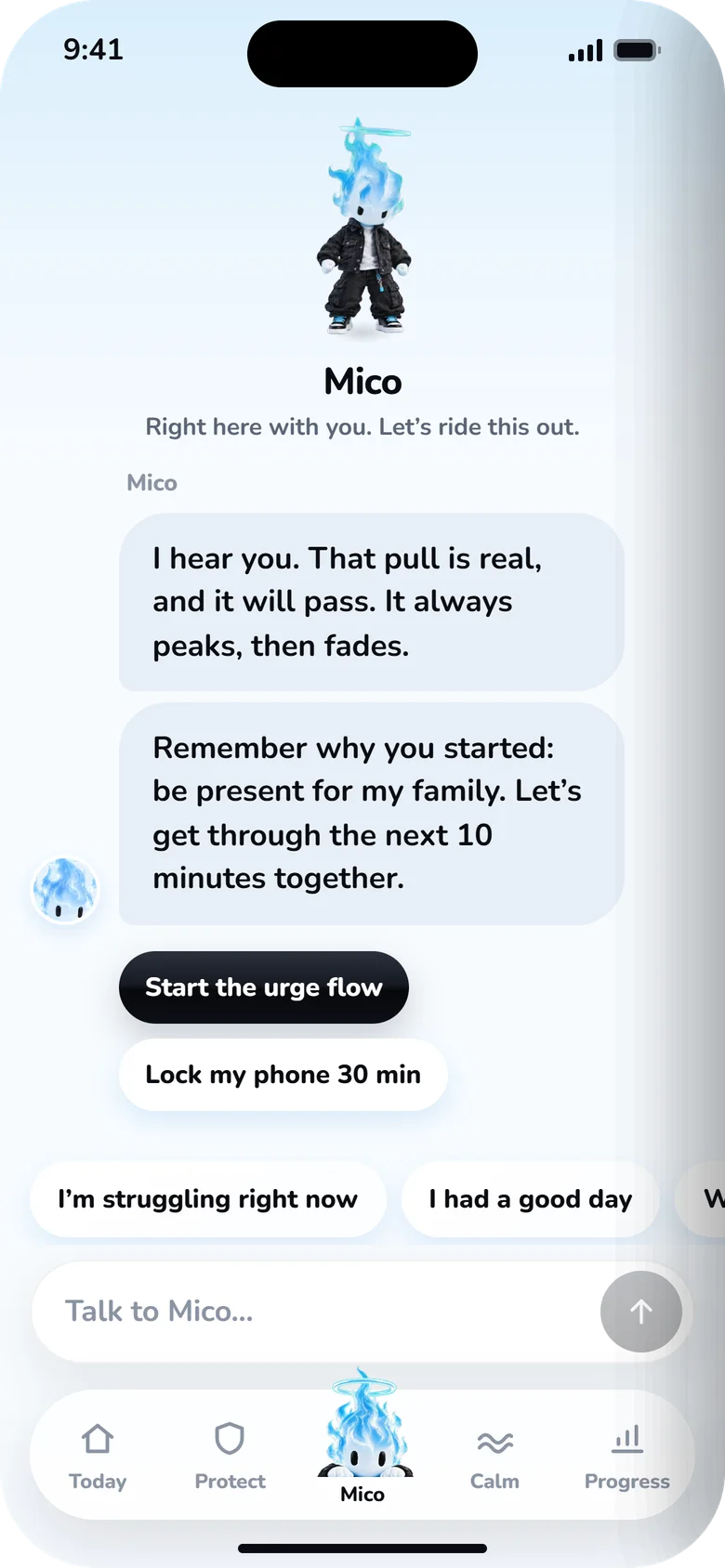
- Talk it through with Mico, Flamico’s AI companion, who knows your reason and never judges.
- Lock your phone for 30 minutes. Calls and messages keep working. Everything else waits until the wave has passed.
By now, ten minutes have gone by. For most urges, that’s enough. If it isn’t, repeat the plan. Urges are persistent, but so are you.
What not to do in the middle of an urge
- Don’t negotiate. “Just a few minutes” and “just a quick look” are the urge talking. Every rule you set in advance is one less argument to lose later.
- Don’t test yourself. Scrolling past explicit content “to prove you can handle it” feeds the habit you’re trying to starve.
- Don’t fight the thought head-on. As the white bear study showed, pushing a thought away tends to bring it back. Notice it, name it, and change what you’re doing instead.
- Don’t stay where you are. Same room, same position, same phone: that’s the habit’s home ground.
- Don’t shame yourself for having urges. Having urges doesn’t mean you’re failing. It means you’re quitting.
After the urge: two minutes that make the next one easier
Once it’s passed, don’t just move on. Take two minutes:
- Write down what triggered it: the time, the place, what you were doing, how you felt.
- Count the win. Every urge you beat is proof you can do it again. Flamico counts them on your Progress screen.
- Fix one gap. If it started with a specific app or late-night scrolling, add a limit or a night lock tonight.
When urges keep coming back: find the pattern
If urges hit at the same times again and again, that’s good news in disguise: predictable urges can be planned for. After a week of notes, you’ll usually spot two or three patterns. A useful shortcut is HALT: are you hungry, angry, lonely or tired? Most urges show up when at least one of those is true.
Then turn each pattern into an if–then plan, a simple rule decided in advance. A review of 94 studies found that plans like these had a medium-to-large effect on whether people reached their goals.6
| If… | Then I will… |
|---|---|
| I get into bed | Leave my phone charging in the kitchen. |
| I’m scrolling with no purpose | Put the phone down and stand up, right away. |
| I get home stressed | Go for a 15-minute walk before I sit down. |
| I feel an urge | Start the 10-minute plan, or press “I feel an urge”. |
The urges that worry people most often come at night. If that’s you, read why porn urges hit at night, and how to protect your evenings. And make sure the easy path is closed in the first place: here’s how to block porn on iPhone and Android.
Why urges often get stronger before they get weaker
Many people are surprised that the first weeks feel harder, not easier. When a habit stops getting what it expects, it tends to push harder for a while, like someone pressing a broken elevator button over and over. Then, slowly, the pressing stops.
So if your urges feel louder right after you start, don’t read it as failure. It usually means the habit is losing its grip and protesting about it. Keep riding the waves. Over weeks, most people notice urges coming less often, passing faster, and feeling less like orders and more like suggestions.
If urges stay intense and constant for months, or come with low mood or anxiety, consider talking to a professional. In one small randomized trial, men who took 12 sessions of acceptance and commitment therapy, which teaches exactly this skill of making room for urges without acting on them, cut their porn viewing by 93%, compared with 21% in the group that waited.7
Make the plan automatic
A plan only helps if you can follow it while your head is foggy. Write it on a card, save it on your home screen, or use an app that runs it for you. In Flamico, one button does all of it.
- Your own video plays first: the reason you recorded on a good day.
- Breathe with Mico for four slow rounds, with sound.
- Choose your way out: lock your phone, move your body for five minutes, or talk it through with Mico.
- Count the win: every urge you beat shows up on your Progress screen.
Urges are part of quitting, not a sign you can’t. For the full plan, from blocking porn to rebuilding your evenings, read how to quit porn and get your life back. And if an urge ever wins, here’s what to do next.
Questions people ask
How long does a porn urge last?
It varies from person to person and from day to day, but urges usually come in waves that build, peak and fade within minutes when you don’t act on them or feed them with more images and thoughts. That’s why a short, ready-made plan works better than trying to hold on for hours.
Is it okay to just distract myself?
Distraction helps, especially if it involves moving your body or leaving the room. It works even better combined with naming the urge, slow breathing and reminding yourself of your reason. That way you’re not only escaping the urge, you’re learning that it passes on its own.
Why do urges get stronger when I try to quit?
When a habit stops getting what it expects, it often pushes harder for a while before the pull fades. Many people notice urges spike in the first weeks, then come less often and with less force. A stronger urge early on is usually a sign the habit is losing, not winning.
What should I do if the urge hits in bed?
Get out of bed and turn on the light. Bed, darkness and a phone in your hand are some of the strongest cues there are, so changing all three at once breaks the loop fastest. Charging your phone outside the bedroom prevents most of these moments from starting.
Does a cold shower stop porn urges?
For many people it helps, because a sudden change in body temperature shifts your attention and your physical state fast. Any strong physical action can work the same way: push-ups, a brisk walk, splashing cold water on your face. Pick the one you’ll actually do.
What if I have urges all day, every day?
Constant, intense urges that disrupt your work, sleep or relationships are worth taking seriously. Make sure your blocks and triggers plan are in place, and consider talking to a therapist experienced with compulsive sexual behavior. Acceptance and commitment therapy, for example, has shown promising results for problematic porn use.
Sources
- Wegner D. M., Schneider D. J., Carter S. R., White T. L. (1987). Paradoxical effects of thought suppression. Journal of Personality and Social Psychology, 53(1), 5–13. doi.org/10.1037/0022-3514.53.1.5
- Bowen S., Marlatt A. (2009). Surfing the urge: Brief mindfulness-based intervention for college student smokers. Psychology of Addictive Behaviors, 23(4), 666–671. doi.org/10.1037/a0017127
- Lieberman M. D., Eisenberger N. I., Crockett M. J., Tom S. M., Pfeifer J. H., Way B. M. (2007). Putting feelings into words: Affect labeling disrupts amygdala activity in response to affective stimuli. Psychological Science, 18(5), 421–428. doi.org/10.1111/j.1467-9280.2007.01916.x
- Zaccaro A., Piarulli A., Laurino M., et al. (2018). How breath-control can change your life: A systematic review on psycho-physiological correlates of slow breathing. Frontiers in Human Neuroscience, 12, 353. doi.org/10.3389/fnhum.2018.00353
- Taylor A. H., Ussher M. H., Faulkner G. (2007). The acute effects of exercise on cigarette cravings, withdrawal symptoms, affect and smoking behaviour: A systematic review. Addiction, 102(4), 534–543. doi.org/10.1111/j.1360-0443.2006.01739.x
- Gollwitzer P. M., Sheeran P. (2006). Implementation intentions and goal achievement: A meta-analysis of effects and processes. Advances in Experimental Social Psychology, 38, 69–119. doi.org/10.1016/S0065-2601(06)38002-1
- Crosby J. M., Twohig M. P. (2016). Acceptance and commitment therapy for problematic internet pornography use: A randomized trial. Behavior Therapy, 47(3), 355–366. doi.org/10.1016/j.beth.2016.02.001
One button for the hardest ten minutes.
Flamico blocks porn on your phone, locks it in one tap when an urge hits, and Mico stays with you until it passes.