 Flamico
Am I addicted to porn? 10 signs you shouldn’t ignore
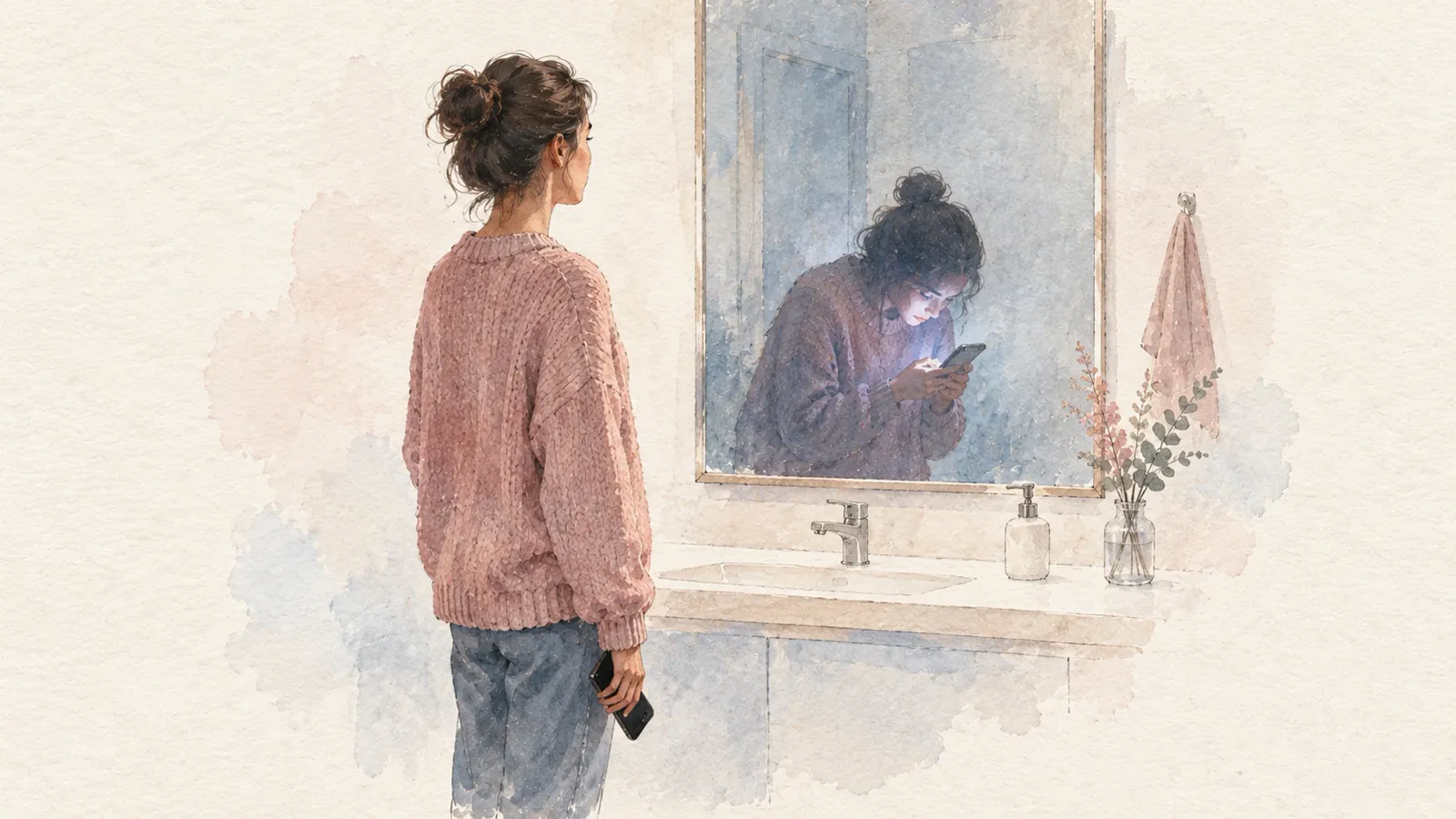
Maybe you closed a tab tonight and thought, “Why do I keep doing this?” Maybe you’ve promised yourself “last time” so often that the words don’t mean much anymore. Asking whether you’re addicted to porn is a brave question, and an honest one. There’s no single number that answers it. But there are clear signs, the same ones researchers use to measure problematic porn use, and this guide walks you through all ten.
First, a straight answer about “porn addiction”
You’re far from alone in asking. In a nationally representative survey of American adults, roughly 11% of men and 3% of women agreed, at least partly, with the statement “I am addicted to pornography”.1 In another national survey, about 10% of men and 7% of women reported real distress about how hard it was to control their sexual urges and behavior.2
Whether to call it an “addiction” is still debated among experts. The World Health Organization uses a different name: compulsive sexual behaviour disorder. It describes a persistent pattern, usually lasting six months or more, of failing to control intense sexual urges, where the behavior becomes central to your life, attempts to cut back keep failing, and it continues despite real harm or little satisfaction.3
Here’s what matters more than the label: does it feel out of your control, and is it costing you things you care about? If the answer is yes, you have a good reason to change, whatever anyone calls it.
This isn’t a diagnosis. The signs below can help you reflect honestly. Only a qualified professional can assess you properly, and if your use comes with low mood, anxiety or thoughts of hurting yourself, please reach out for help.
How researchers measure problem porn use
Scientists who study this don’t just count hours. One widely used tool, the Problematic Pornography Consumption Scale, looks at six areas: how much porn takes up your mind, whether you use it to change your mood, whether it causes conflict in your life, whether you need more over time, whether you keep going back after trying to stop, and how you feel when you can’t watch.4 Shorter screens exist too, such as the five-question Brief Pornography Screen used in clinical research.5
The ten signs below are built around those same ideas, in plain language.
The 10 signs
1. You’ve tried to stop, and couldn’t
You’ve deleted the history, made the promise, maybe even gone a few days. Then you were back. Repeated, failed attempts to stop are one of the clearest signs that a habit has more control than you’d like. It’s also one of the core features in the WHO’s description.
Ask yourself: How many times have I said “this is the last time”?
2. It takes far more time than you meant
You plan five minutes and lose an hour. You stay up much later than you wanted. Those hours add up quietly: one hour a night is about fifteen full days a year.
Ask yourself: Do I usually stop when I planned to?
3. It’s your go-to escape from feelings
Stressed, bored, lonely, rejected, anxious, can’t sleep: porn has become the default answer. When something becomes your main way to cope, the feelings underneath never get dealt with, and the habit grows stronger every time it “works”.
Ask yourself: Do I reach for it most when I feel bad?
4. You need more extreme or newer content
What used to be enough doesn’t do it anymore. You find yourself searching for things you wouldn’t have watched before, sometimes things that clash with your own values. Needing more to get the same effect is one of the classic patterns in compulsive behavior.
Ask yourself: Has what I watch changed in ways that bother me?
5. It’s on your mind when you’re not watching
You plan around it. You notice when you’ll be alone. You think about it at work, in class, or in the middle of a conversation. When something starts taking up that much space in your head, it’s no longer just something you do now and then.
Ask yourself: How much of my day does it occupy, even when I’m not watching?
6. It affects your real-life intimacy
You feel less interested in, or less present with, a real partner. You compare them, or yourself, to what you watch. You might notice changes in your sexual response. If you have physical symptoms, please see a doctor: they can have many causes, including stress, sleep and health conditions.
Ask yourself: Is it getting between me and the people I care about?
7. You hide it, and feel worse afterward
Private browsing, cleared history, a second account, a locked folder. Then a heavy feeling once it’s over. Secrecy and shame tend to feed each other: you feel bad, you want to escape the feeling, and porn is the escape.
Ask yourself: Would I be comfortable if the people closest to me knew how much I watch?
8. It gets in the way of work, sleep or goals
You watch at work or in class. You’re tired because you stayed up. You keep pushing back the project, the workout, the plans that matter to you. When a habit keeps stealing from the things you actually want, that’s a real cost.
Ask yourself: What would I do with those hours if porn wasn’t taking them?
9. You keep going despite real consequences
It has caused arguments, broken trust, a problem at work, or money spent you didn’t plan to spend, and it still feels hard to stop. Continuing despite clear harm is another of the central features doctors look for.
Ask yourself: Has it already cost me something important, and I still haven’t stopped?
10. You feel restless or irritable when you can’t watch
When you try to take a break, you might notice strong urges, irritability or trouble sleeping. Research here is still young. In a randomized study where regular users tried to stop for a week, the average participant didn’t show clear withdrawal symptoms, but heavier daily users with more problematic use did report stronger cravings.6 So if stopping feels unusually hard for you, take it seriously.
Ask yourself: How do I feel on the days I don’t watch?
A quick, honest self-check
Count how many of the ten signs describe you most of the time over the past six months, not on one bad night.
| Signs that fit | What it might mean | A good next step |
|---|---|---|
| 0 to 2 | Porn probably isn’t running your life, but if something bothers you, that’s still valid. | Notice when and why you watch. Remove easy access if you want to cut it out. |
| 3 to 5 | A pattern is forming that’s harder to control than you’d like. | Build a real plan: blocks, a plan for urges, and one person you can talk to. |
| 6 or more | Porn has a strong hold and is costing you real things. | Make a full plan today, and consider talking to a professional. |
This isn’t a scientific score, only a way to see your situation more clearly. If you’re anywhere on this table and you want to change, you don’t need permission or a diagnosis. Wanting your time, focus and self-respect back is reason enough.
Feeling guilty doesn’t automatically mean you’re addicted
This part is especially important if your faith or values are part of why you want to quit. Research shows that when people feel their porn use clashes with their values, they tend to feel more addicted and more distressed, regardless of how much they actually watch.7 That’s also why the WHO notes that distress coming only from moral disapproval isn’t, on its own, enough to indicate a disorder.3
None of this means your values are wrong. Wanting to live by what you believe is a powerful, legitimate reason to quit, whatever the label. It just means two things are worth separating:
- Control and consequences: can you stop, and what is it costing you? That tells you how much help you may need.
- Guilt and values: does it clash with who you want to be? That tells you why you want to change.
Both matter. Neither one needs shame. Shame tends to push people back toward porn as a way to escape it. Keep your standard high, and treat yourself the way you’d treat a friend who’s trying.
What to do if you recognized yourself
Recognizing a few of these signs doesn’t make you broken. It makes you honest, and honesty is where change starts. Here’s a simple way to begin, today:
- Write your reason in one sentence. Not “because it’s bad”, but what porn is taking from you and what you want instead.
- Remove easy access on your phone and every other device. Follow our guides for iPhone and Android.
- Have a plan for urges before they hit. Try our 10-minute plan.
- Tell one person you trust. Secrecy is fuel. Saying it out loud takes away a lot of its power.
- Know what to expect. The first weeks can feel harder before they feel easier. Here’s what happens when you quit porn, day by day.
For the whole step-by-step plan, read how to quit porn and get your life back.
When to talk to a professional
Consider professional help if you recognized six or more signs, if you’ve tried to stop many times without success, or if porn use comes with depression, anxiety, trauma, or other compulsive behaviors like gambling or drinking. Help works. In one small randomized trial, men who took 12 sessions of acceptance and commitment therapy cut their porn viewing by 93%, compared with 21% in the group that waited for treatment.8
Look for a therapist experienced with compulsive sexual behavior. And if you ever feel hopeless or think about hurting yourself, contact a crisis line right away: in the US, call or text 988, or find a free local line at findahelpline.com.
How Flamico can help
If you saw yourself in this list, you don’t have to fight it with willpower alone. Flamico is built for exactly this moment.
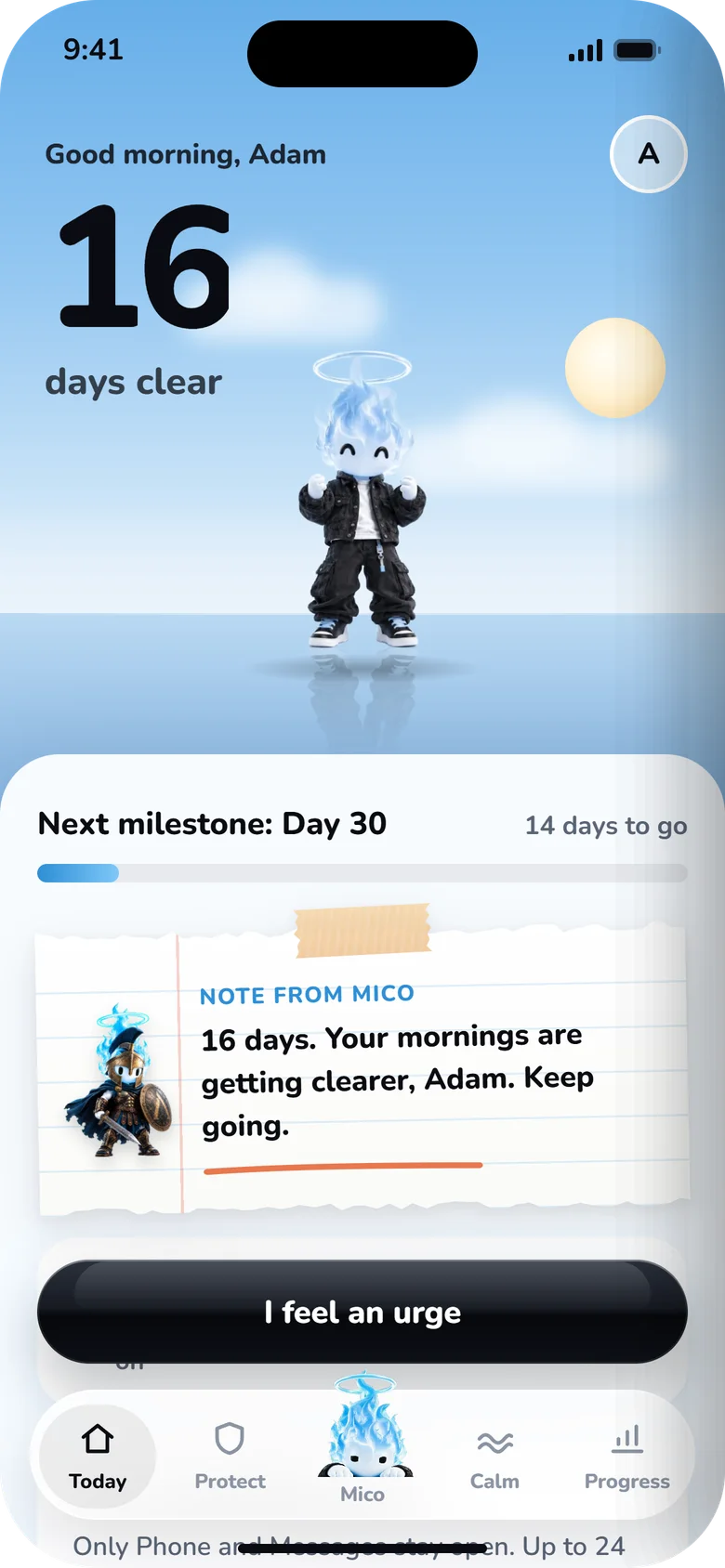
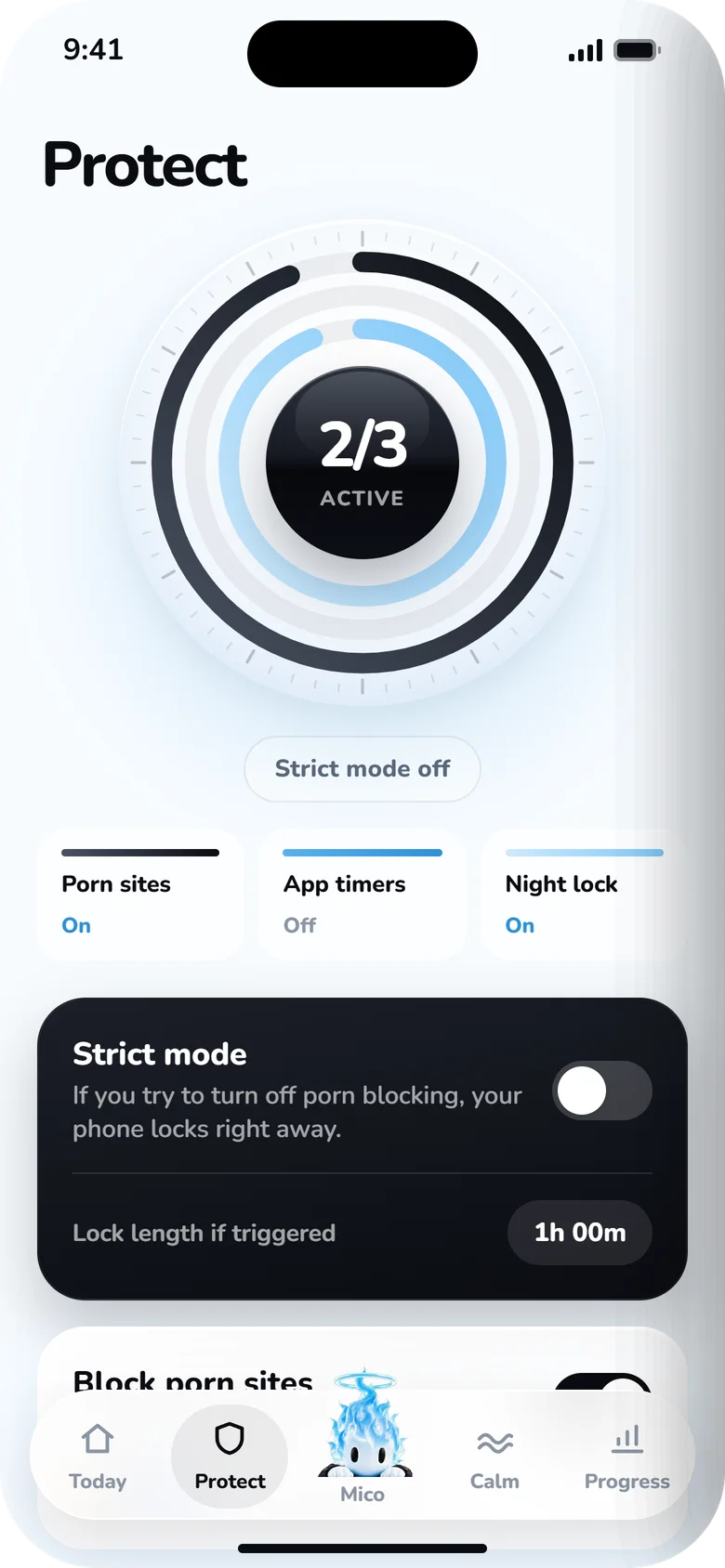
- Blocks porn in every browser and app, and makes the block hard to undo in a weak moment.
- Helps in the moment: press “I feel an urge” for your own video, breathing with Mico and a way out.
- Shows your patterns: the hours your urges usually hit, and how your streak grows.
- No shame, ever: a slip resets your current streak, never your longest one.
Questions people ask
Is porn addiction a real diagnosis?
Experts still debate the word “addiction”. The World Health Organization’s ICD-11 includes compulsive sexual behaviour disorder, which can involve pornography: a long-lasting pattern of failing to control intense sexual urges that causes real distress or harm. Whatever the label, what matters is whether your use feels out of your control and is costing you things you care about.
How much porn is too much?
There’s no safe or unsafe number of hours. Two people can watch the same amount and have very different experiences. The better questions are what it costs you, such as time, sleep, focus, relationships and self-respect, and whether you can stop when you decide to.
Is there a test for porn addiction?
There are research screening tools, like the five-question Brief Pornography Screen and the Problematic Pornography Consumption Scale, that help identify problematic use. They’re screens, not diagnoses. If you score high on one, or recognize many of the signs on this page, talking to a qualified professional is the best next step.
Can women be addicted to porn?
Yes. Problematic porn use is more often reported by men, but women experience it too. In a large US survey, 7% of women and about 10% of men reported significant distress about difficulty controlling their sexual urges and behavior. The signs and the steps to change are the same.
Does watching porn every day mean I’m addicted?
Not automatically. Frequency alone doesn’t define a problem. But daily use combined with failed attempts to stop, using porn to escape feelings, or real costs in your life is a strong signal worth taking seriously.
I feel guilty after watching porn. Does that mean I’m addicted?
Not necessarily. Guilt can come from your values, and that’s a valid reason to quit on its own. But the World Health Organization notes that distress coming only from moral disapproval doesn’t by itself indicate a disorder. Look at control and consequences, not just guilt.
Should I see a professional?
If your use feels out of your control, keeps coming back despite real effort, or comes with depression, anxiety, trauma or other compulsive behaviors, yes. A therapist experienced with compulsive sexual behavior can help, and treatments like acceptance and commitment therapy have shown promising results.
Sources
- Grubbs J. B., Kraus S. W., Perry S. L. (2019). Self-reported addiction to pornography in a nationally representative sample: The roles of use habits, religiousness, and moral incongruence. Journal of Behavioral Addictions, 8(1), 88–93. doi.org/10.1556/2006.7.2018.134
- Dickenson J. A., Gleason N., Coleman E., Miner M. H. (2018). Prevalence of distress associated with difficulty controlling sexual urges, feelings, and behaviors in the United States. JAMA Network Open, 1(7), e184468. doi.org/10.1001/jamanetworkopen.2018.4468
- World Health Organization. ICD-11 for Mortality and Morbidity Statistics, 6C72 Compulsive sexual behaviour disorder. icd.who.int/browse/2024-01/mms/en#1630268048
- Bőthe B., Tóth-Király I., Zsila Á., Griffiths M. D., Demetrovics Z., Orosz G. (2018). The development of the Problematic Pornography Consumption Scale (PPCS). The Journal of Sex Research, 55(3), 395–406. doi.org/10.1080/00224499.2017.1291798
- Kraus S. W., Gola M., Grubbs J. B., et al. (2020). Validation of a Brief Pornography Screen across multiple samples. Journal of Behavioral Addictions, 9(2), 259–271. doi.org/10.1556/2006.2020.00038
- Fernandez D. P., Kuss D. J., Justice L. V., Fernandez E. F., Griffiths M. D. (2023). Effects of a 7-day pornography abstinence period on withdrawal-related symptoms in regular pornography users: A randomized controlled study. Archives of Sexual Behavior, 52(4), 1819–1840. doi.org/10.1007/s10508-022-02519-w
- Grubbs J. B., Perry S. L. (2019). Moral incongruence and pornography use: A critical review and integration. The Journal of Sex Research, 56(1), 29–37. doi.org/10.1080/00224499.2018.1427204
- Crosby J. M., Twohig M. P. (2016). Acceptance and commitment therapy for problematic internet pornography use: A randomized trial. Behavior Therapy, 47(3), 355–366. doi.org/10.1016/j.beth.2016.02.001
If you saw yourself here, start today.
Flamico blocks porn on your phone, locks it in one tap when an urge hits, and Mico stays with you until it passes.