 Flamico
What happens when you quit porn: a realistic 90-day timeline

You’ve decided to quit. Now you want to know what you’re in for: will it get harder, when will it get easier, and what will actually change? Here’s an honest 90-day timeline based on what people commonly report and what the research says, without the miracle promises. Everyone’s path is different, but knowing what’s normal makes the hard days much easier to get through.
Your 90 days at a glance
| When | What’s common | What helps most |
|---|---|---|
| Days 1 to 3 | High motivation, then the first real urge at your usual time | Blocks on every device, your reason where you can see it |
| Days 4 to 14 | Urges can get louder; restlessness, poor sleep, “just once” thoughts | A ready plan for urges, exercise, protecting your hardest hours |
| Days 15 to 30 | First real wins: urges less often, quicker recovery, more time | Counting wins, filling evenings with something better |
| Days 31 to 60 | Things feel easier, and that’s when overconfidence sneaks in | Keeping every protection on, even when you feel strong |
| Days 61 to 90 | A new normal: porn stops being the default answer | Building the life you don’t want to escape from |
Why 90 days?
The 90-day goal comes from online recovery communities, not from a scientific study, and it’s worth being honest about that. Still, it’s a useful target. It’s long enough to live through every kind of week, stressful ones, boring ones, celebrations, and to build new routines that start to feel like yours.
What research does tell us is that changing a habit takes time, and how much time varies a lot. In a well-known study on forming new habits, the time it took for a behavior to become automatic ranged from 18 to 254 days.1 So if you’re not “done” at day 90, nothing is wrong with you. And if things feel easier earlier, don’t take that as a reason to drop your guard.
Days 1 to 3: the decision feels easy, then it doesn’t
Motivation is high at the start. You’ve made a decision, maybe set up some blocks, and it feels good. Then the first strong urge arrives, usually at your usual time and in your usual place: in bed, alone with your phone, bored, or stressed after a long day.
That urge doesn’t mean you’re failing. It’s the habit asking for its routine. This is the moment the plan you made in calmer hours earns its keep.
- Block porn on every device before day one is over. Here’s how on iPhone and Android.
- Put your reason where you’ll see it, or record a short video of yourself explaining why this matters.
- Charge your phone outside the bedroom from night one.
Days 4 to 14: urges can get louder
Many people are surprised that the first two weeks can feel harder, not easier. When a habit stops getting what it expects, it often pushes harder for a while before it gives up. You might notice restlessness, irritability, trouble sleeping, or your mind drifting back to “just once”.
How hard this phase is depends on where you start. In a randomized study where regular porn users stopped for a week, the average participant didn’t show clear withdrawal symptoms. But the heaviest daily users with more problematic use did report stronger cravings.2 So if you watched every day, expect these two weeks to test you, and know that it’s normal.
The key skill here is riding out urges without feeding them. In a study with smokers, people who learned to notice a craving and let it pass didn’t feel weaker urges at first, but they acted on them much less.3 Movement helps too: short bouts of exercise have been shown to reduce cravings.4
- Use a short, ready-made routine for every urge. Here’s our 10-minute plan.
- Move your body every day, even a 20-minute walk.
- Protect your hardest hours with a night lock or Downtime.
Days 15 to 30: the first real wins
For many people, this is when things start to shift. Urges come less often, and when they do, they pass faster. People commonly describe:
- More time in the evenings, and less guilt in the mornings.
- Better focus at work or school.
- Feeling more present in conversations and with the people around them.
- A growing, quiet confidence: “I can actually do this.”
This is a good time to start filling the space porn used to take. Pick one thing that gives you visible progress, like training for something, learning a skill, a project, or regular time with people. The fuller your days get, the less room porn has.
Days 31 to 60: the overconfidence trap
Things feel easier now, and that’s exactly what makes this phase risky. The urges are quieter, so the blocks start to feel unnecessary. You loosen one “just for now”, scroll a little longer in bed, or tell yourself one look won’t matter. Then a stressful week arrives and catches you off guard.
Relapse researchers have long described this pattern: slips often come in high-risk moments, like stress, loneliness, or being back in an old setting, rather than at random.5 Feeling strong is great. It’s just not a reason to remove the guardrails.
- Keep every protection on, even when you feel you don’t need it.
- Plan for the hard weeks you can see coming: travel, exams, a breakup, a big deadline.
- Check in with your reason once a week, not only when things get hard.
Days 61 to 90: a new normal
Around this stage, many people find that porn is simply no longer the default response to stress or boredom. Urges still visit, but they feel more like passing suggestions than orders. Some people notice changes in their mood, energy and motivation, and in how they experience closeness and intimacy.
Some people go through a quieter phase along the way, with low motivation or low libido, often called a “flatline”. Experiences vary a lot and there’s very little research on it. It usually passes, but if you feel persistently low, or something worries you about your mood or sexual health, talk to a doctor.
Day 90 and beyond
Day 90 is worth celebrating. It is not a finish line. Long-term success usually comes less from resisting porn and more from needing it less: better sleep, regular exercise, real connection, meaningful work, and healthier ways to handle stress. Over time, porn becomes something you used to do, not something you’re constantly fighting.
Stay humble about hard days. A breakup, loneliness, a move or a stressful stretch can bring old urges back, even after months. That’s normal, and it’s exactly what your plan and protections are for.
What people commonly notice after quitting
Research on specific benefits of quitting porn is still limited, so treat this as what people often report, not a guarantee:
- Time: evenings and nights that feel like yours again. One hour a night adds up to about fifteen days a year.
- Energy and sleep: going to bed earlier instead of scrolling late.
- Focus: fewer distractions, more follow-through on goals.
- Relationships: more presence, less comparison, less secrecy.
- Self-respect: living closer to your own values, with nothing to hide.
Those last two often matter most. Many people say the biggest change wasn’t any single benefit. It was no longer living with a secret.
What about sex and erections?
This is one of the most common worries, so let’s be clear. Erectile difficulties have many possible causes, including stress, performance anxiety, poor sleep, alcohol, some medications and physical health conditions. Some people find their sexual response improves after cutting out porn. But if you have ongoing difficulties, please see a doctor rather than waiting it out. It may have nothing to do with porn, and many causes are easy to treat.
If you slip along the way
Many people slip somewhere in these 90 days. It doesn’t erase what you’ve built. In the habit study mentioned above, missing one opportunity did not materially affect the habit-forming process.1 What matters is what you do next: don’t let “the streak is gone anyway” turn one slip into a binge, figure out what led to it, fix one gap, and keep going today.
Here’s exactly what to do: relapsed after quitting porn? Read this before you give up.
Track the trend, not just the streak
Your streak is motivating, but it’s only one number. Change is easier to see over weeks than day to day, so track a few things:
- How often urges hit, and at what times.
- How many urges you rode out.
- How quickly you bounce back after a hard moment.
- Your longest streak, which always counts, even after a slip.
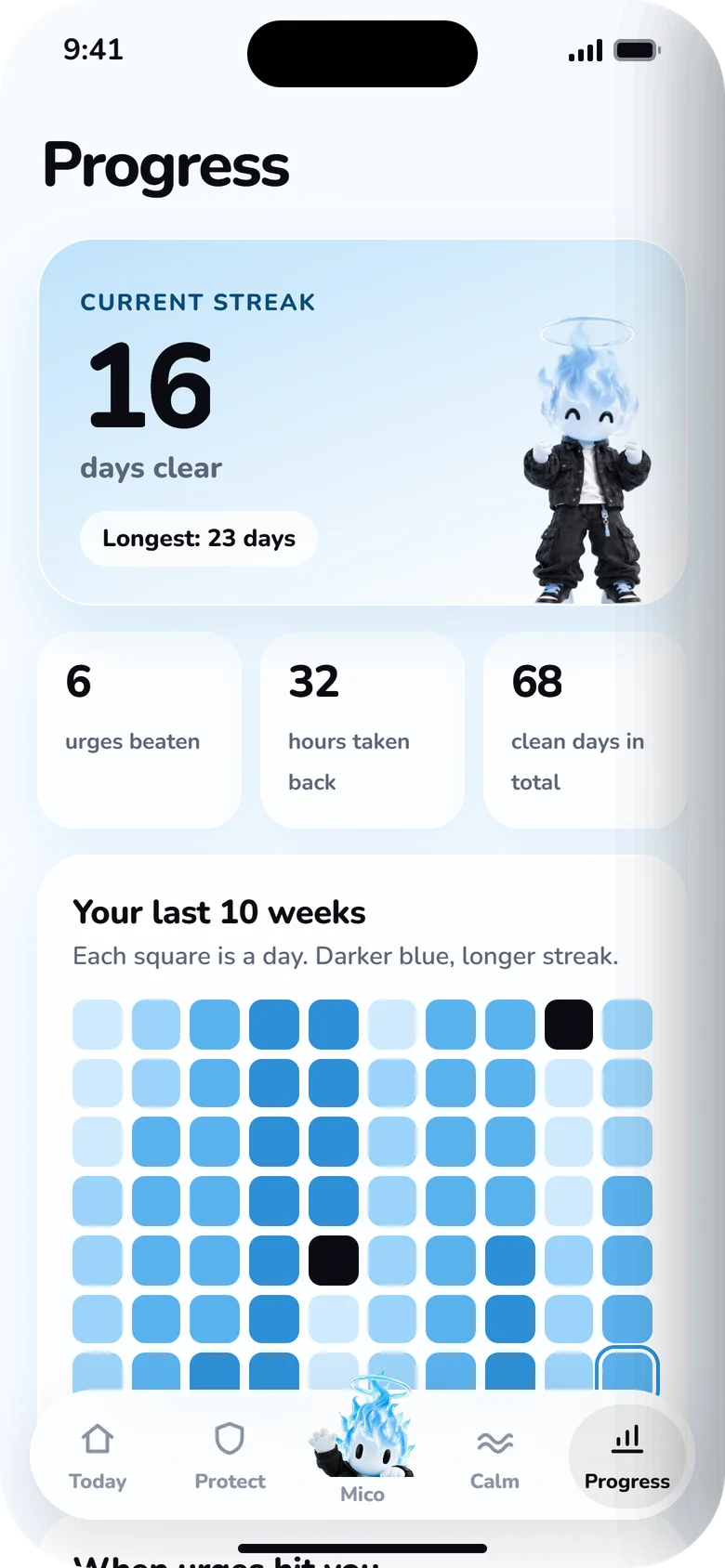
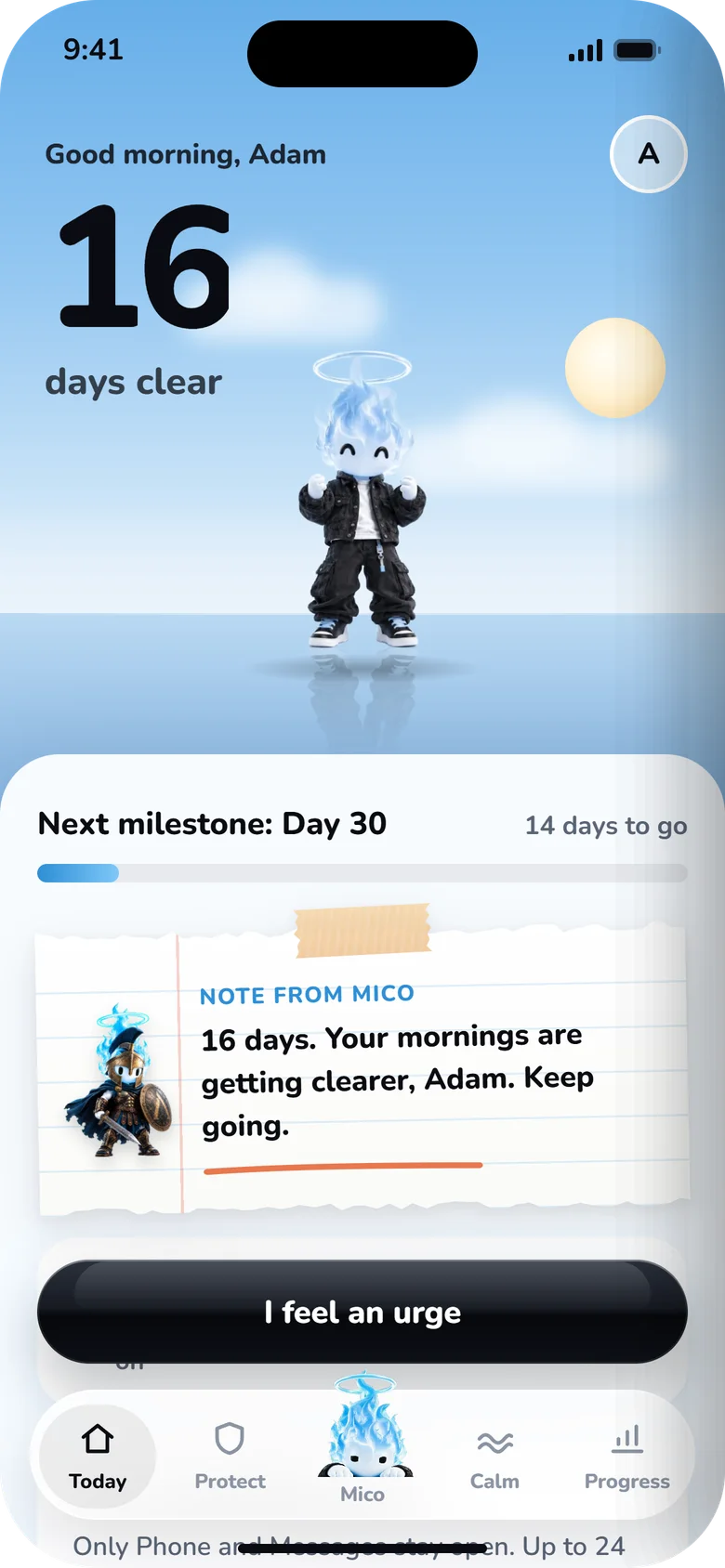
Flamico does this for you. The Progress screen shows your current and longest streak, the urges you’ve beaten and the hours they usually hit, and celebrates milestones along the way at days 1, 3, 7, 14, 30, 60 and 90. A slip resets your current streak, never your longest one.
Ready to start your 90 days? Read the full plan: how to quit porn and get your life back. Not sure yet whether porn is really a problem for you? Start with am I addicted to porn? 10 signs you shouldn’t ignore.
Questions people ask
Is 90 days enough to quit porn?
Ninety days is a popular milestone, and it’s long enough for new routines to start feeling like yours. But there’s no scientific rule that says 90 is the magic number. In habit research, the time it took for a new behavior to become automatic ranged from 18 to 254 days. Treat day 90 as a checkpoint, not a finish line.
Is there a flatline after quitting porn?
Some people describe a phase a few weeks in with low motivation or low libido, often called a “flatline”. Experiences vary a lot and there’s very little research on it. If you feel persistently low, or you’re worried about your mood or sexual health, talk to a doctor.
Will quitting porn fix erectile problems?
Erectile difficulties have many possible causes, including stress, anxiety, sleep, alcohol, medication and physical health conditions. Some people find their sexual response improves after cutting out porn, but it’s important to see a doctor to rule out medical causes.
Will I have withdrawal symptoms when I quit porn?
Most people don’t get dramatic physical withdrawal. In a randomized study where regular users stopped for a week, the average participant showed no clear withdrawal symptoms. Heavier daily users with more problematic use did report stronger cravings, so the first week may feel harder if that’s you.
What if I don’t feel any different after quitting?
That’s common, especially early on. Change is often gradual and easier to see looking back than day to day. Track a few things weekly, like how often urges hit, how you sleep and how you spend your evenings, and compare month to month.
Do I have to quit masturbation too?
That’s a personal decision, and people choose differently. Some find a break helps them reset, others don’t. What matters most is that your line is clear and decided in advance, so you never have to negotiate with yourself in the middle of an urge.
Sources
- Lally P., van Jaarsveld C. H. M., Potts H. W. W., Wardle J. (2010). How are habits formed: Modelling habit formation in the real world. European Journal of Social Psychology, 40(6), 998–1009. doi.org/10.1002/ejsp.674
- Fernandez D. P., Kuss D. J., Justice L. V., Fernandez E. F., Griffiths M. D. (2023). Effects of a 7-day pornography abstinence period on withdrawal-related symptoms in regular pornography users: A randomized controlled study. Archives of Sexual Behavior, 52(4), 1819–1840. doi.org/10.1007/s10508-022-02519-w
- Bowen S., Marlatt A. (2009). Surfing the urge: Brief mindfulness-based intervention for college student smokers. Psychology of Addictive Behaviors, 23(4), 666–671. doi.org/10.1037/a0017127
- Taylor A. H., Ussher M. H., Faulkner G. (2007). The acute effects of exercise on cigarette cravings, withdrawal symptoms, affect and smoking behaviour: A systematic review. Addiction, 102(4), 534–543. doi.org/10.1111/j.1360-0443.2006.01739.x
- Hendershot C. S., Witkiewitz K., George W. H., Marlatt G. A. (2011). Relapse prevention for addictive behaviors. Substance Abuse Treatment, Prevention, and Policy, 6, 17. doi.org/10.1186/1747-597X-6-17
Start day one today.
Flamico blocks porn on your phone, locks it in one tap when an urge hits, and Mico stays with you until it passes.